Sunday, 17 May 2009

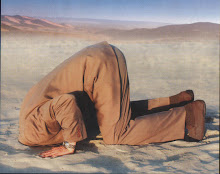
what do you see?


blindness by Josee Saramago was recommended and lent to me by a new good friend when i said i was loving south american authors and had a thing for disaster/apocolyptic movies that involved diseases (think outbreak and 28 days later). he was right, the book was right up my alley; i found it both chilling and powerful.

the prose is stripped down and unencumbered. saramango never tells the reader the city or the year that the story takes place and the characters are never named beyond physical identifiers or professions - the girl with the dark glasses, the boy with the squint, the first blind man, the doctor. this gives us a sense that these things matter little, it could be any place, any time, any people.

the story gets underway when the first man becomes blind while waiting at a traffic light. unlike traditional blindness the man sees the world as white rather than black. after being helped home, the man visits an ophthalmologist with his wife, but the puzzled doctor is unable to give them any answers. the next day, it becomes apparent that the white blindness is an infectious disease - many more people are blind, including the eye doctor, his clinic patients and the first blind man's wife. the state steps in to quarantine the blind. they are sent to an old asylum and guarded by the military who are ordered to shoot anyone who tries to leave.

more and more blind people are brought to the asylum everyday and there is no one to help them do baic human things. food deliveries are infrequent and often do not take into account the added number of blind that continue to arrive. toilet and cleaning facilities are limited and quickly soiled by people who cannot see what they are doing. no medicines are available and there is no easy way to bury the dead.

amongst all of these blind people there continues to be one sighted individual. the doctor's wife who pretended to be blind so that she would be taken to the quarantine facility with her husband never loses her sight throughout the story. instead she is the only visual witness to the horror and carnage that is humanity at it's basest level. she uses her immunity to blindness to shepherd her husband and the blind charges in her ward so that they might live in as much comfort and safety as is possible in the circumstances.

i found the story revealing - it is how i imagine society would deteriorate in such a situation. the small ward containing the doctor and his seeing wife maintained a commitment to dignity and turned to each other to get through an intolerable situation. they thought of others instead of only themselves. however they were a clear minority.

there was also a group on the opposite end of the spectrum that sought to take advantage despite being blind themselves. this group took control of the only resource of any value to the blind detainees, the food supply. with the other inmates at their mercy and no hope of outside intervention this group traded valuables for food and when material valuables ran out, they demanded women for sexual services.

between these two extremes was the rest of humanity - the 90% of people who were self-interested, scared and opportunistic. exactly how most of us would be in a crisis. it terrifies me that when things go wrong, when one of our basic expectations as a person is removed, it is almost as if our humanity falls away. we forget what it is that makes us human. or even further, is humanity a luxury item? something that expresses itself only when we feel our basic needs are taken care of first.

Saturday, 10 January 2009

all happy families are alike...


i really meant to start off my blog about reading with something classic and great like anna karenina, something that would make me look serious and pensive...you know, to set the tone for the blog and what not. something i even happened to be reading at the time thanks to the recommendation of my bestest pal. unfortunately i'm still not finished anna, so figured i'd start out with some other material, tone of the blog be damned. i hardly ever read just one book at a time, particularly when we're talking about the long tomes of tolstoy. it's nothing personal, i just that if i find something i really want to read, i can never seem to wait...

anyways, so while taking a break from anna, which by the way is thoroughly enjoyable...i'm so glad to be giving leo another chance after reading war and peace as a teenager...i've actually read several books. i've just moved to a new city, so am getting a lot more quality (read: enforced) reading time. seeing as the local bookstore, in this case chapters, is something i always locate within a few days of moving to make me feel at home, i found myself looking around for something new to read as per. the cover for charlotte roche's 'wetlands' jumped out at me. it's bright pink with half an avacado on the front. i know what they say about not judging a book by its cover, but bollox to that. in my mind there are so many books out there and i need something to judge them on. the inside cover claimed that the book was changing the conversation about female identity and sexuality around the world. intriguing. it also mentioned that it was explicit and fantastically sexual. sold.

i finished the book that day...it was bizarre and outspoken, not to mention exceptionally explicit. actually i don't think explicit quite covers it. the narrator, helen, is an 18 year old girl in germany struggling to identify herself as a sexual and mature woman while also desperately wanting to throw up two fingers to the established rules and regulations of society like any good teenager. i have never read a book that so graphically describes bodies and what people do with their bodies in the privacy of their bedrooms and bathrooms. sometimes the intimacy of it was frankly uncomfortable. and i get the feeling that helen knows that and takes a great deal of pleasure in it.

we meet helen as she is entering the hospital to have surgery on an infected anal lesion. that pretty much sets the stage for the types of things we are about to learn about her. not only do we get an intimate look at her current injury, but also an insider view of her sexual preferences and daily hygiene habits. if helen's stories are to be believed she has an exceptionally healthy and liberal sexual appetite. she should be writing a sex column to help the more prudish members of society (read: pretty much anyone i've ever met!). however, the sex is not sexy, this is clearly not a mis-categorized piece of erotica, but it is exceptionally detailed and very matter-of-fact.

we also get an inside look at helen's hygiene routine from popping pimples and shaving to how she avoids a 'chocolate dip' when preparing for anal sex. helen's biggest form of rebellion seems to be in her fight against what she sees as the repressive nature of traditional hygiene. she fights girlish cleanliness at every chance she gets and takes a lot of joy in the thought of spreading bacteria...often by leaving bits of toilet paper covered in menstrual blood in random locations. i feel like helen has a point, maybe an extreme point, but a point nonetheless. especially as women, we are taught to be disgusted by our bodies and told that they need to be disinfected and perfumed on a daily basis to remain healthy and attractive. this is of course rubbish. too many people are afraid or turned-off by what our bodies naturally do.

despite all of her sexual bravado, helen is also quite obviously a lost little girl. her parents are divorced (she hopes to get them back together by meeting in her hospital room) and she describes a scenario where she comes home from school to find her mother and brother asleep on the floor with the gas on and the oven door open, something she isn't sure if she dreamed or really happened. she sees her mother as a tyrant of traditional femininity and has a difficult time relating to her father.

overall i found the book extremely interesting, though often shocking, not necessarily in its detail, but in how i related to these details. i don't know that the asserted aims on the jacket were achieved...that the conversation was changed about female identity and sexuality...but there was certainly an interesting discourse being introduced. i liked 'wetland' for its honesty and frankness and i felt more than a little commonality with the ideas of the mixed up, overtly sexual teenaged narrator.